When a data center is proposed nearby, the debate can quickly become divided between two simple messages: “This will be great for the community” and “This will be terrible for the community.”
Neither conclusion can be reached responsibly from the words data center alone.
What will this particular project require, what will it provide, who will pay for the supporting infrastructure, and how will the benefits and impacts be distributed?
Potential Benefits Can Be Significant
Large data-center developments can represent billions of dollars in private investment. Construction can create work for electricians, equipment operators, pipefitters, engineers, concrete crews, and other skilled trades. Once operating, facilities employ technical, maintenance, security, engineering, and support personnel.
Depending on local tax laws and incentives, data centers can also become important sources of tax revenue.
Infrastructure built for a project may sometimes provide broader benefits. New substations, transmission improvements, roads, fiber connections, or other investments can strengthen systems used by other customers—particularly when the developer bears the cost.
But those outcomes are not automatic.
The Same Project Can Create New Demands
A large data center is not simply another commercial building.
It may require an unusually large electrical connection, new utility infrastructure, significant construction activity, extensive land, and—in some designs—substantial water for cooling.
That can raise practical local questions:
- Will new transmission lines or substations be needed?
- Could local water or wastewater systems require expansion?
- Who pays for those improvements?
- How will construction affect roads and traffic?
- How close will the facility be to homes, schools, or other sensitive locations?
- What happens if the campus expands beyond its first phase?
The U.S. Department of Energy has specifically identified energy prices, noise, water use, land footprint, construction impacts, housing, sensitive nearby areas, transmission, and community engagement as issues worth considering in data-center siting and development.
Noise and Appearance Can Matter Locally
Data centers may look quiet from the outside, but operating facilities contain mechanical and electrical equipment that can create continuous sound. Cooling equipment, generators during testing or emergencies, transformers, and other systems can all contribute.
Whether that becomes a meaningful problem depends heavily on facility design, distance from neighbors, topography, sound mitigation, and local conditions.
Visual impact is similarly site-specific. A large campus may include massive buildings, substations, transmission infrastructure, fencing, lighting, and backup equipment.
A project located in an established industrial area may therefore affect its surroundings very differently from the same development placed near residential property.
Who Pays for Infrastructure Is a Crucial Question
Perhaps the most important community issue is not simply how much infrastructure a data center needs, but who ultimately pays for it.
Large electrical loads can require generation, transmission, substations, and other upgrades. How those costs are allocated depends on utility rules, contracts, regulators, and the structure of the individual project.
Some recent projects have included arrangements intended to place new power and delivery costs directly on the data-center developer rather than ordinary ratepayers. That illustrates why the financial structure matters as much as the size of the electrical load.
The same principle applies to roads, water systems, sewer capacity, and other public infrastructure.
There Is No Universal Community Impact
This is the central point.
A data center built on previously developed industrial land with privately funded infrastructure and substantial local tax payments presents a different community equation from a project requiring major public infrastructure expansion near homes or constrained water resources.
Even two facilities of similar physical size can have different electricity demand, cooling systems, water requirements, tax arrangements, employment levels, and expansion plans.
That is why communities are better served by examining the actual proposal rather than deciding whether data centers are universally “good” or “bad.”
Questions Worth Asking Before Taking a Position
A useful local discussion should eventually answer questions such as:
- How large will the completed campus actually be?
- How much electricity and water will it require?
- What infrastructure must be built or upgraded?
- Who pays for those upgrades?
- What taxes will the project actually pay after incentives?
- How many permanent jobs will remain after construction?
- What noise, traffic, lighting, and land-use impacts are expected?
- What protections or mitigation measures are part of the agreement?
Those questions move the conversation away from slogans and toward something much more useful: understanding the tradeoffs.
And that is ultimately the best way to evaluate a data-center proposal—project by project, number by number, and claim by claim.
Related: Do Data Centers Create Jobs and Tax Revenue?
Related: How Much Electricity Do Data Centers Use?
Related: How Much Water Do Data Centers Use?
WANT THE COMPLETE GUIDE?
See How All the Pieces Fit Together
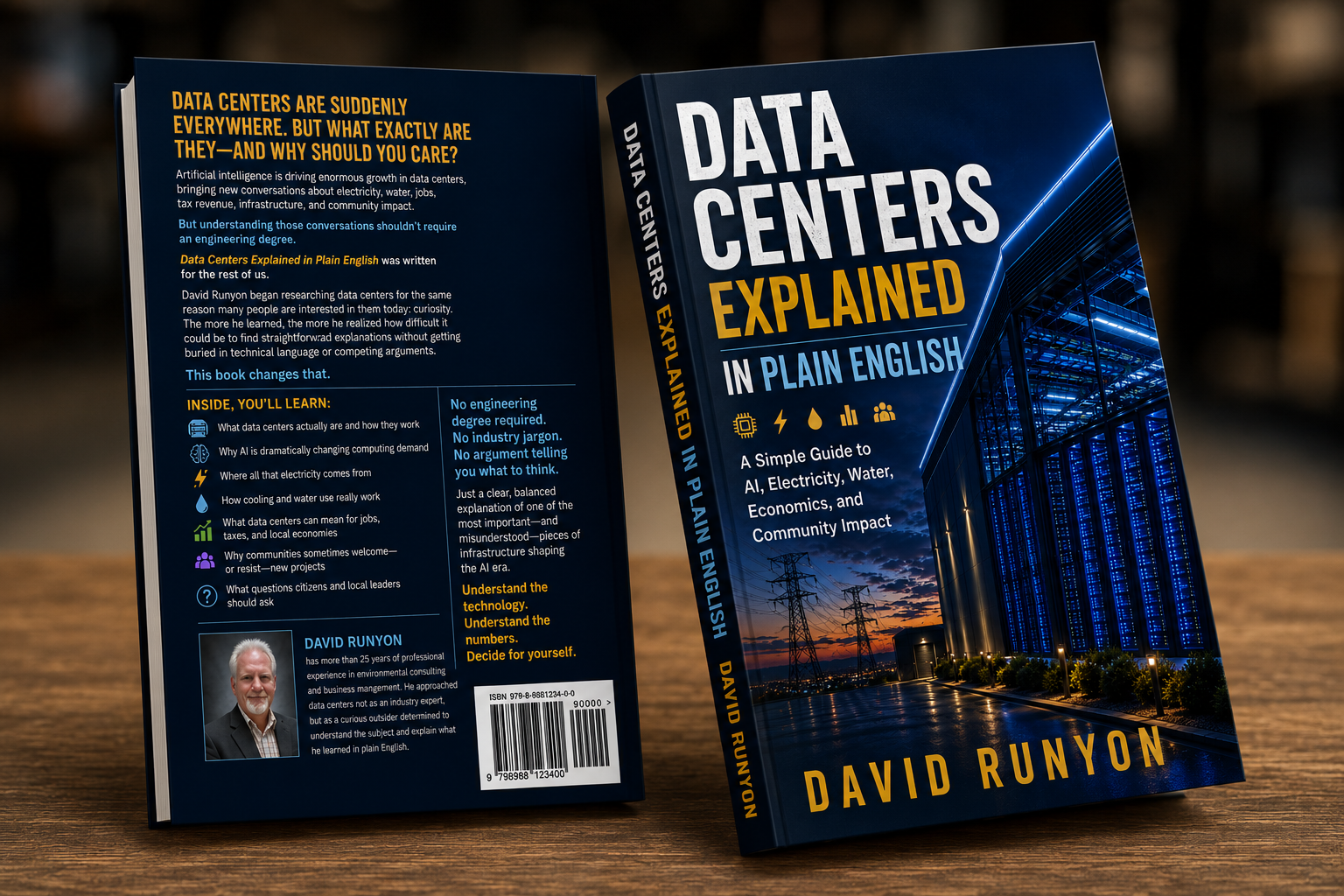
Data Centers Explained in Plain English connects AI, electricity, water, economics, infrastructure, and community impact in one easy-to-follow guide.
Understand the technology. Understand the numbers. Decide for yourself.
Prefer a printed copy or Kindle? Amazon has you covered. Want to start reading right now? The complete PDF is just $9.99.
Sources & Further Reading
Educational information only. Community impacts vary substantially by project, location, utility arrangements, cooling design, tax structure, infrastructure requirements, and surrounding land uses.