Data-center proposals seem to be appearing everywhere. Some involve individual buildings. Others describe enormous campuses planned in multiple phases over several years.
Why the sudden rush?
Demand for computing is growing quickly, especially from AI, while the electricity, land, fiber, and equipment needed to support very large facilities can take years to secure.
AI Accelerated an Existing Trend
Data centers were expanding long before generative AI became widely known. Businesses had already been moving computing and storage into cloud platforms, while streaming, online commerce, social media, financial systems, and other digital services continued to grow.
AI added a new source of demand.
Modern AI systems can require large numbers of specialized processors operating together. The International Energy Agency says AI is accelerating deployment of high-performance servers and contributing significantly to rising data-center electricity demand.
The IEA projects global data-center electricity consumption in its base case to rise from about 415 TWh in 2024 to roughly 945 TWh in 2030.
That projection is uncertain, but it helps explain why technology companies are planning ahead rather than waiting to see exactly how large AI becomes.
The Race Is Also About Electricity
A company can buy servers much faster than a utility can necessarily build the infrastructure required to power them.
Large data centers may need substations, transformers, transmission upgrades, new generation, or other grid improvements. Those projects can require planning, permitting, equipment, construction, and regulatory approval.
Lawrence Berkeley National Laboratory reported in 2026 that rapid growth from data centers and other large electricity users is already creating connection bottlenecks in parts of the United States.
This creates an unusual competitive pressure:
A suitable site with access to large amounts of electricity may be more valuable than an empty piece of land alone.
Why Companies Plan Such Large Campuses
Many announcements describe a potential completed campus rather than a facility that will appear all at once.
A developer may secure enough land and infrastructure for several buildings, then construct them in phases as customer demand develops.
This is important when interpreting headline numbers.
A proposed 500-MW or 1-GW campus does not necessarily mean the entire electrical load will appear immediately—or even that every planned phase will ultimately be built.
The announced number may represent the project's long-term potential.
Speed Creates Its Own Questions
The rapid pace of development is one reason data centers have become a public issue rather than simply a technology-industry story.
Communities and utilities are being asked to make decisions about projects whose future computing demand can be difficult to predict.
That raises questions such as:
- How much of the announced campus will actually be built?
- How quickly will its electricity demand appear?
- What infrastructure must be constructed first?
- Who pays for that infrastructure?
- What happens if AI demand grows slower—or faster—than expected?
The Boom Is Real, but the Future Is Not Certain
Data-center growth is clearly accelerating. The IEA says data centers are expected to account for roughly half of U.S. electricity-demand growth through 2030.
But forecasts are not guarantees.
More efficient processors, better software, changing AI adoption, economic conditions, electricity constraints, and new technologies could all change how much infrastructure is ultimately needed.
So the useful question is not simply, “Why are so many data centers being announced?”
It is also:
Which projects are likely to be built, how large will they actually become, and what must happen before they can operate?
Related: Why Does AI Need Data Centers?
Related: Who Pays for Data Center Power Infrastructure?
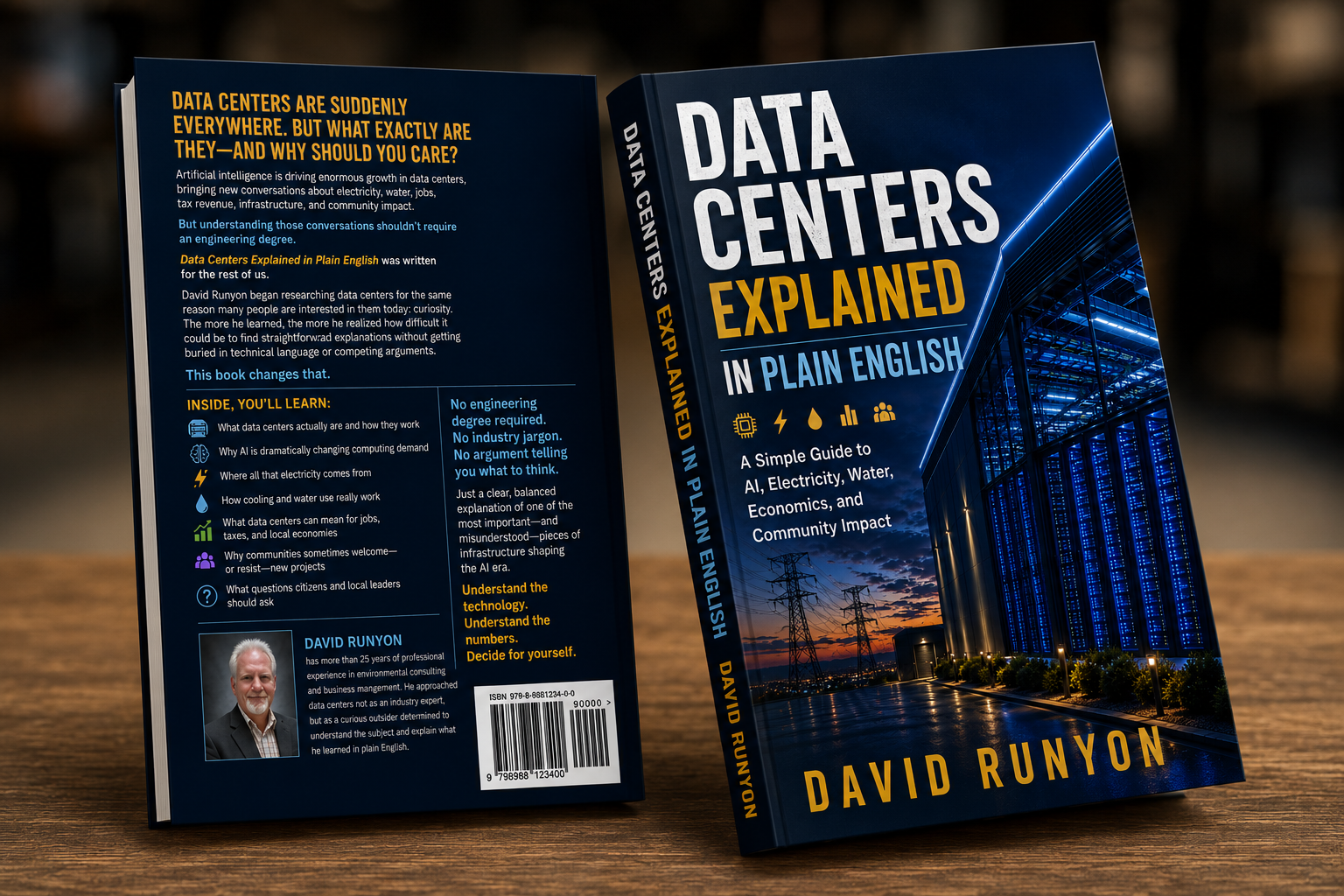
WANT THE COMPLETE GUIDE?
See How All the Pieces Fit Together
Data Centers Explained in Plain English connects AI growth, electricity, infrastructure, water, economics, and community impact in one easy-to-follow guide.
Understand the technology. Understand the numbers. Decide for yourself.
Prefer a printed copy or Kindle? Amazon has you covered. Want to start reading right now? The complete PDF is just $9.99.
Sources & Further Reading
Educational information only. Data-center development plans, electricity requirements, construction schedules, and future AI demand can change substantially over time.