You probably use a data center dozens—perhaps hundreds—of times every day without realizing it.
Stream a movie. Check your email. Make an online purchase. Store photographs in the cloud. Search the internet. Ask an AI assistant a question. Access an online bank account.
Somewhere behind those everyday activities are computers processing, storing, and moving information. Many of those computers live inside data centers.
Data centers have become increasingly important as cloud computing, streaming services, online businesses, and artificial intelligence have grown. At the same time, enormous new data-center projects are raising questions about electricity, water, jobs, taxes, land use, and community impact.
A data center is a specialized facility where computer systems and the infrastructure needed to operate them are housed.
But that simple definition only begins to explain what is happening inside.
Think Beyond a Building Full of Computers
It's tempting to picture a data center as a warehouse filled with computers. That's partly correct—but incomplete.
The computers are certainly important. Depending on the facility, there may be thousands of servers arranged in rows of equipment racks. But those computers cannot operate by themselves.
They need reliable electricity. They generate heat that must be removed. They need extremely fast network connections. They need protection from electrical interruptions. They need physical and digital security.
And because many digital services are expected to operate around the clock, data centers often include backup systems designed to keep equipment running when something goes wrong.
A better way to think about a modern data center is as several major infrastructure systems working together. Computing is only one of them.
What's Actually Inside a Data Center?
Although facilities differ considerably, several systems are common.
Servers and Computing Equipment
Servers are specialized computers that perform much of the actual computing work. They may process transactions, host websites, store information, stream content, run business applications, support cloud services, or perform calculations for artificial intelligence.
Modern AI facilities may also contain large numbers of specialized processors designed for extremely demanding computational workloads.
Networking Equipment
Information has to move into, out of, and throughout the facility. Routers, switches, fiber-optic connections, and other networking equipment provide those connections.
A building containing enormous computing power wouldn't be particularly useful if information couldn't move quickly between those computers and the outside world.
Electrical Infrastructure
Computers require electricity—and large data centers can require a great deal of it.
Electrical infrastructure can include substations, transformers, switchgear, power distribution equipment, uninterruptible power supplies, batteries, and backup generators. Reliability is especially important because interruptions can affect the digital services supported by the facility.
Cooling Systems
Computers turn some of the electricity they consume into heat. Put thousands of powerful computers together and removing that heat becomes a major engineering challenge.
Data centers therefore use cooling systems to maintain acceptable operating temperatures. Depending on the design and climate, those systems may involve air cooling, chilled-water systems, cooling towers, evaporative cooling, liquid cooling, or combinations of technologies.
Some cooling designs can consume substantial amounts of water, while other designs can greatly reduce or avoid on-site water consumption. Actual water use depends on cooling technology, climate, operating conditions, and other factors.
Why Do Data Centers Need So Much Electricity?
Part of the answer is simply scale.
A single computer doesn't use an extraordinary amount of electricity. Put thousands of powerful computers together, operate them continuously, add networking equipment, cooling systems, pumps, fans, electrical equipment, lighting, and other supporting infrastructure, and the total requirement becomes much larger.
Artificial intelligence has made this discussion even more important. AI computing can require large numbers of specialized, high-performance processors operating together. These systems can concentrate much more computing power—and therefore much more electrical demand—into a relatively small area than many traditional computing environments.
This has led to increasingly large proposed data-center projects and new questions for utilities and communities.
- Where will the electricity come from?
- Will new transmission lines or substations be required?
- Who pays for those improvements?
- Could large new loads affect other electricity customers?
Those questions don't always have the same answers. The details matter.
Why Is Water Part of the Conversation?
Water is frequently mentioned in discussions about data centers because certain cooling systems use it to help remove heat. But this is an area where oversimplification can create confusion.
Some facilities may consume substantial quantities of water. Others may use significantly less. Climate, cooling technology, operating conditions, computing density, facility design, and even the time of year can affect water requirements.
There's also an important distinction between water withdrawal and water consumption. Those terms are sometimes used as though they mean the same thing, but they don't necessarily describe the same thing.
Understanding distinctions like these becomes increasingly important when communities evaluate proposed projects. A very large number without context can sound alarming. A very small number without context can sound reassuring. Neither necessarily tells you enough by itself.
Why Are So Many Data Centers Being Built?
For years, our digital lives have been expanding. Cloud computing moved applications and storage away from individual computers and into remote infrastructure. Streaming replaced many physical forms of media. Businesses moved more operations online. Smartphones created enormous demand for always-available digital services. Online commerce expanded. The amount of information being created and stored increased dramatically.
Then artificial intelligence added another major source of computing demand.
AI didn't create the data-center industry, but it has accelerated demand for certain types of high-performance computing infrastructure. That's one reason communities that rarely discussed data centers a decade ago may suddenly find themselves considering projects involving large sites, major electrical infrastructure, and very large investments.
Are Data Centers Good or Bad for Communities?
This may be the wrong question.
What are the likely benefits, costs, tradeoffs, and uncertainties of this particular project in this particular location?
Potential benefits can include construction activity, tax revenue, infrastructure investment, economic development, and permanent employment.
Potential concerns can include land use, electrical infrastructure, water demand, noise, environmental effects, tax incentives, utility costs, and how development affects surrounding property.
Even employment requires context. A major data center can represent an enormous capital investment without necessarily employing as many permanent workers as another type of development involving a similar physical footprint.
That doesn't automatically make the investment good or bad. It means the numbers need to be understood.
Five Questions Worth Asking About Any Data Center Project
- How much electrical capacity is being requested—and how much energy is the facility actually expected to consume?
Power and energy are related, but they are not the same measurement. - What cooling system will the facility use?
That can significantly affect both electricity and water requirements. - What new infrastructure will be required?
Substations, transmission lines, pipelines, roads, and other improvements may be part of a large project. - What are the projected economic benefits?
Look beyond the total investment figure. Consider permanent jobs, construction employment, taxes, incentives, and other measurable effects. - Who pays, who benefits, and who carries the risks?
This may be one of the most useful questions in evaluating almost any major infrastructure development.
The Bigger Picture
One of the most interesting things about data centers is that they sit at the intersection of several subjects that are usually discussed separately: technology, artificial intelligence, electricity generation, transmission infrastructure, water, land development, tax policy, economic development, environmental impact, and community planning.
A decision made in one area can affect several others. That's why understanding data centers requires looking beyond the servers.
It's also why simple claims such as “data centers are great for communities” or “data centers are terrible for communities” aren't particularly helpful. The real story is more complicated—and considerably more interesting.
WANT THE WHOLE PICTURE?
Go Beyond the Introduction
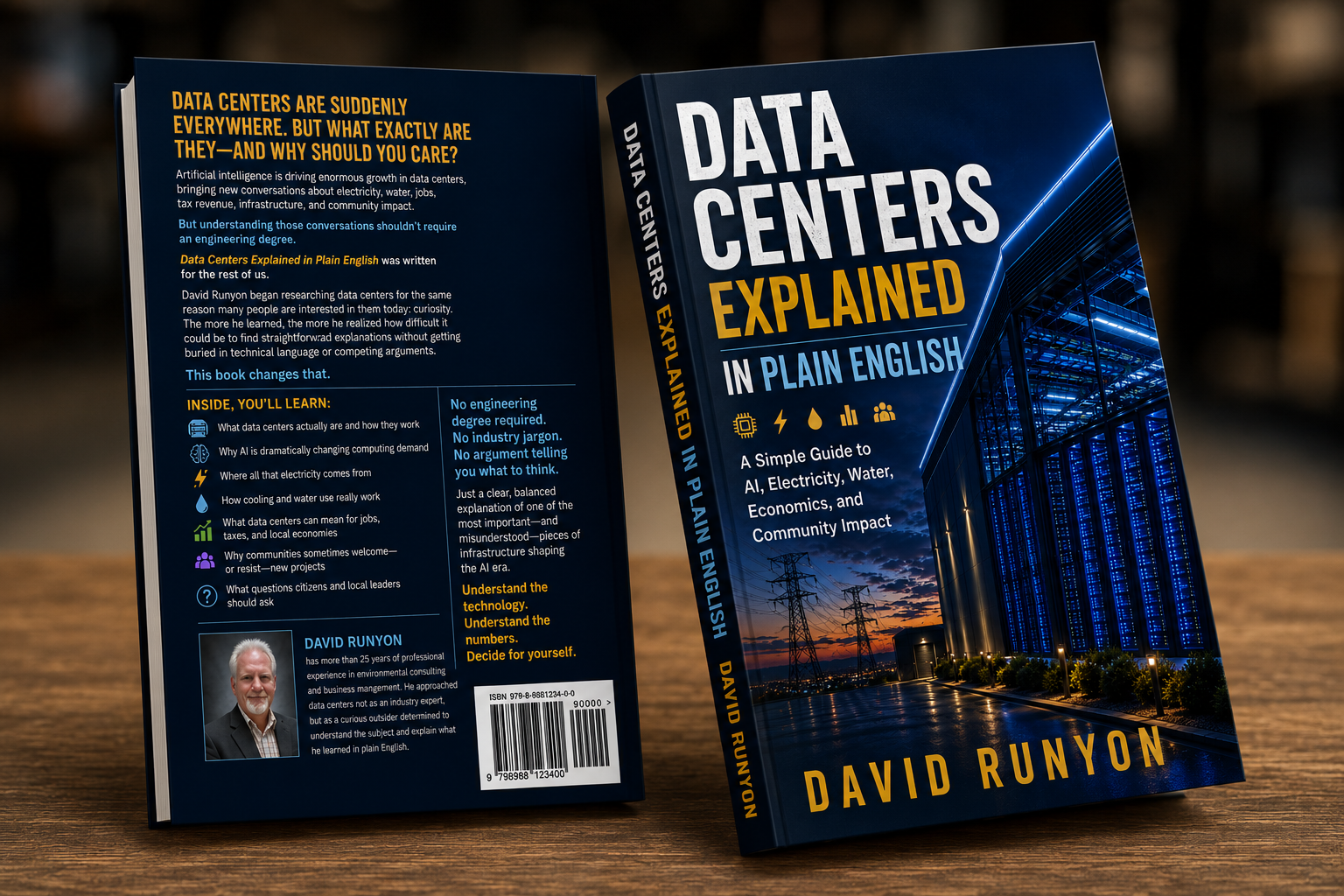
This article gives you the foundation. Data Centers Explained in Plain English connects the bigger questions about AI, electricity, cooling, water, economics, infrastructure, and community impact in one easy-to-follow guide.
The goal isn't to convince you to support data centers—or oppose them. It's to give you enough understandable information to evaluate the claims, numbers, benefits, concerns, and tradeoffs for yourself.
Understand the technology. Understand the numbers. Decide for yourself.
Prefer a printed copy or Kindle? Amazon has you covered. Want to start reading right now? The complete PDF is just $9.99.
Sources & Further Reading
This introductory article was reviewed against authoritative technical and energy sources. For readers who want to explore the underlying material:
- International Energy Agency — Energy and AI: Energy demand from AI
- International Energy Agency — Artificial Intelligence and Energy
- Lawrence Berkeley National Laboratory — Water Use in Data Center Workloads
- National Institute of Standards and Technology — Data Center Cooling and Thermal Management Reference
Educational information only. Data-center designs and impacts vary significantly by facility, technology, utility system, climate, and location.